
Giving the spreadsheet a new job
The Blueprint · shipped 2021–present
- Role
- Platform Architect / Sole Engineer
- Timeframe
- Web application from 2021, across several generations.
- Technologies
- Strapi
- PostgreSQL
- CSV
- Skills
- Technical architecture
- Strapi schema design
- CSV import and export
- Admin tooling
Separated the editorial workflow the spreadsheet encoded from the delivery medium that had become unreliable, moved event data to a structured backend, and when CMS forms damaged bulk editorial work, restored tabular editing through CSV templates and batched imports rather than reverting or telling the team to adapt
About the project
The Blueprint is a free SXSW event guide for Austin whose community, editorial voice, and trusted spreadsheet predate the software. I began building the web application in 2021 and have owned its product and technical implementation end to end since.
- Organization
- When Where What
- Timeframe
- 2021–present
- 80,382
- Registered users
- 4,304
- Activations across years
- 358
- Staff picks
Overview
Editing the guide and delivering it
The Blueprint began with an editorial team publishing event information in a spreadsheet. As the audience grew, the sheet was carrying both the work of assembling the guide and the work of delivering it to readers.
I moved the delivery into a web application and later migrated the data to Strapi and PostgreSQL. That gave me a structured model and API, but the CMS forms made bulk editing harder. I brought tabular editing back through CSV templates and batched imports, keeping the backend responsible for storing and serving the records.
Reading the existing workflow
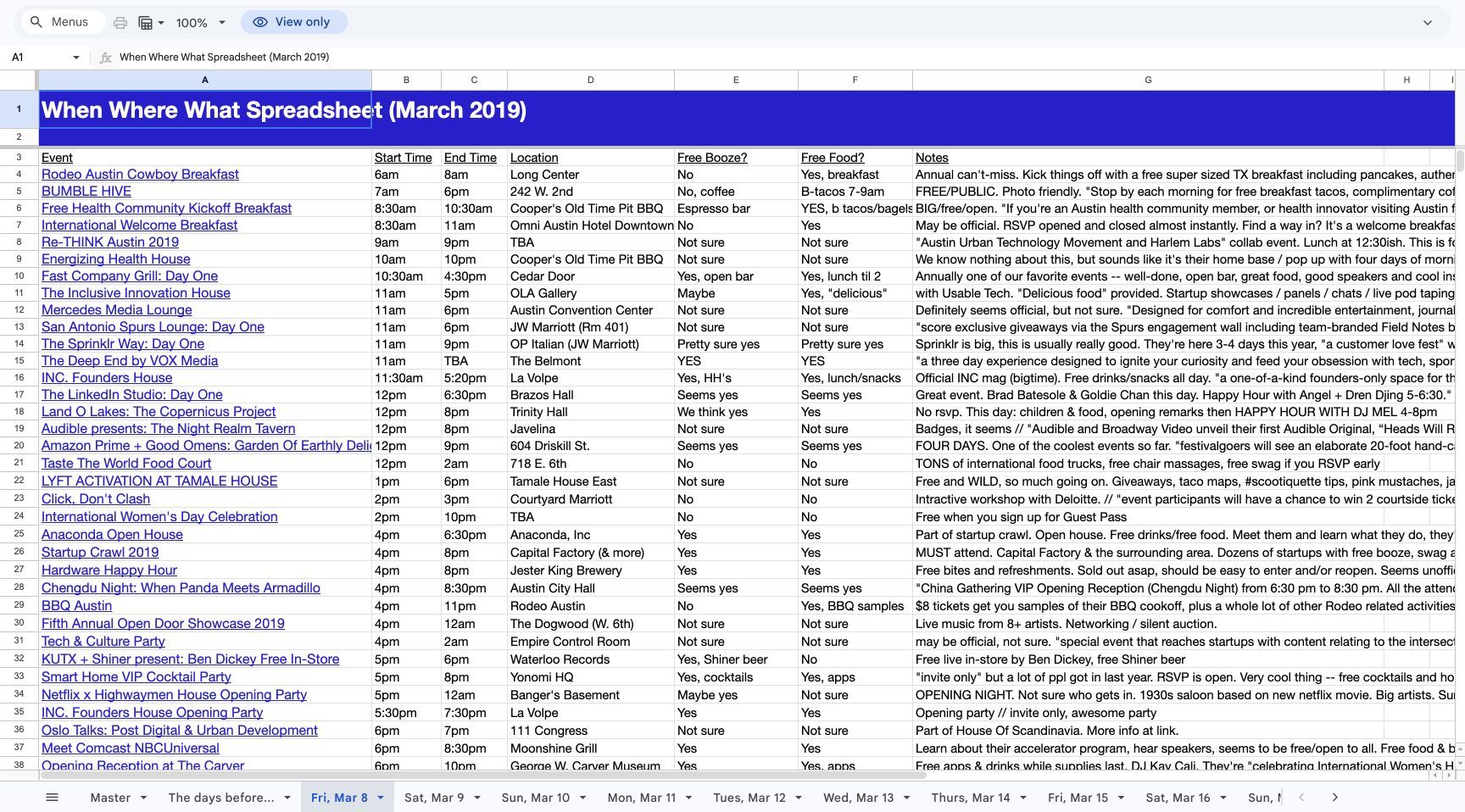
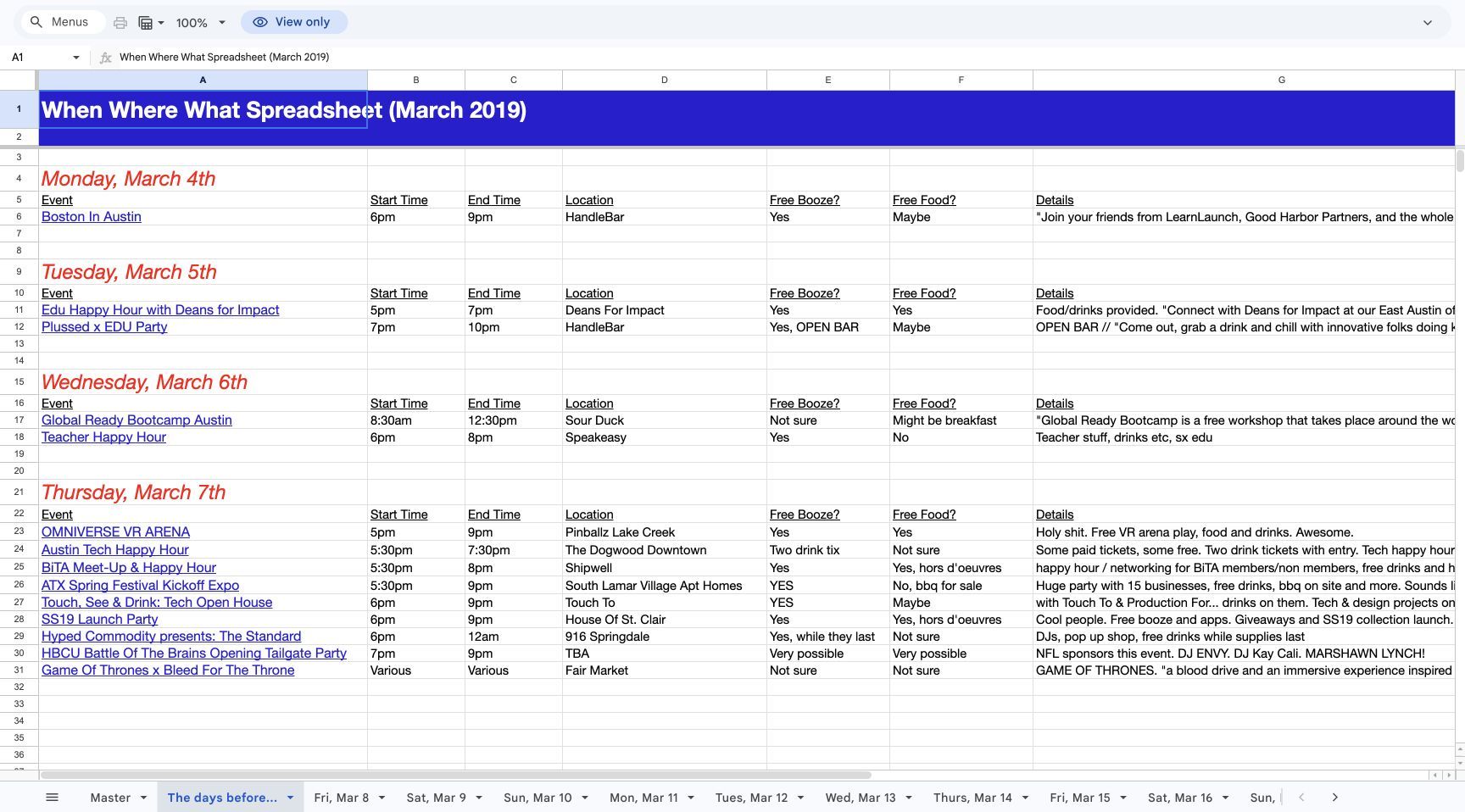
The 2019 When Where What Spreadsheet had a tab for each festival day, a Master tab, and a tab called “The days before...” Each event had a name, start and end times, venue, and notes. Editors could compare a day's listings without opening each one separately.
The “Free Booze?” and “Free Food?” columns also carried uncertainty. Entries such as “Not sure,” “Pretty sure yes,” and “Yes, lunch til 2” told readers more than a checkbox would. The sheet held judgments about what the team knew and what a visitor could expect.
That workflow belonged to the editorial team. My job was to support it while changing how the information reached a much larger audience. Replacing the file required understanding which parts of the work depended on its shape.
Improving delivery and slowing editing
The first separation kept the sheet as the source of truth. An Apps Script layer normalized and shaped its rows for a mobile web client. Editors continued working in the same place while readers received a different presentation. The script source has not been recovered; this part of the history is my account of the work.
Later, I moved the records to Strapi with PostgreSQL on Heroku. Content types, relations, and validation made the data easier to use consistently. CMS forms gave editors a way to work on individual records.
The difficulty appeared across records. Scanning many events, spotting an incorrect time, or making several related corrections had been straightforward in a grid. Working through separate forms added navigation and removed that shared view. I had improved the data structure while making a frequent editorial task slower.
Solution
Returning the grid as an input
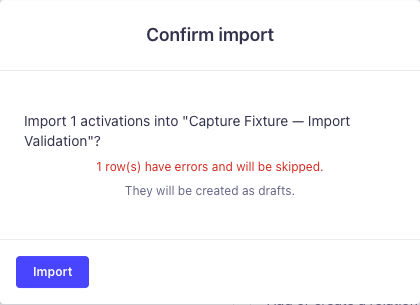
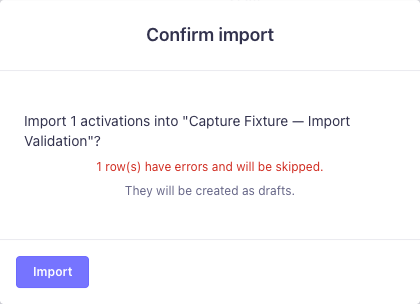
I added CSV templates and batch imports so editors could prepare multiple activations at once. The importer associated them with the relevant main event and validated the input. The interface exposes a mismatch in the error handling: the preview says invalid rows will be skipped, but the backend rejects the entire invalid batch. Correcting the missing name allows both rows to be imported as drafts.
The template made the expected columns explicit. It also created a contract I had to maintain as the model changed. Editors could still use CMS forms for individual records; the import added a path for work that benefited from seeing many entries at once.
The blank activation template records that input format and contains only column headings. The upload sequence below shows both the failure and the corrected outcome with representative records.
I applied the same approach to other recurring tasks: user exports, bulk activation uploads, and scheduled geocoding became admin operations. Those tools needed to express the task in terms someone could operate without manually intervening in the database.
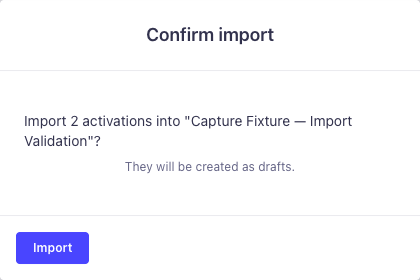

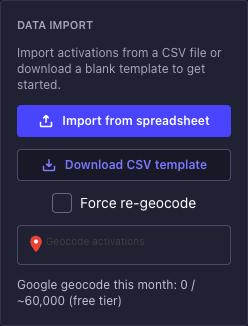
Batch import restores tabular editing. Forms remain available for individual records, alongside routine admin operations.
Reflection
Keeping the workflow without restoring the old delivery
The CSV path let me retain the structured backend without requiring the team to do all of its work through individual forms. It also left two ways to change the same records, with templates, validation, and error messages to maintain alongside the CMS.
The earlier Apps Script step had preserved editing while changing delivery. During the CMS migration, I changed both and only recognized the editing cost through use. That correction matters more to me than the choice of file format: I had to account for the team's work as part of the system I was building.
I can point to the importer and admin tooling as implemented changes. I do not have a measured before-and-after editing time. The basis for this decision is the workflow regression I observed and the input path I built in response to it. The capture also leaves a concrete issue to address: the preview and backend need to describe the same failure behavior.